On the Inside Looking Out: LGBTQIA+ Health, Policy, and the Efficacy of Hope

The APF Franklyn Springfield LGBTQIA+ Congressional Fellowship offers psychologists the opportunity to apply their expertise in a legislative setting, driving meaningful change at the intersection of psychology and government. By equipping psychologists with hands-on policy experience, this fellowship allows experts in psychology to ensure that policies are responsive to the needs and lived experiences of LGBTQIA+ people.
In this blog post, 2025 Fellow Dr. Aaron Hunt reflects on his fellowship journey, where he worked in the office of U.S. Senator Tammy Duckworth. During his fellowship, he supported policy and oversight efforts across health, disability, and Veterans Affairs, contributing to conversations on inclusive health care access, civil rights protections, and mental health initiatives affecting transgender and gender-diverse veterans and the broader public.
The opinions expressed in this post are the author’s own and do not necessarily reflect the views of the American Psychological Foundation.
As a clinical psychologist, health equity researcher, and person living in DC with a perhaps unhealthy level of interest in politics (shocking), I have always understood health as something shaped not only by individuals’ biology and behavior, but also by policy, culture, and the systems in which people live and work. My year as a Springfield Congressional Fellow with the office of U.S. Senator Tammy Duckworth offered the rare opportunity to bring all of these identities together. Serving in her office allowed me to contribute directly to national conversations about Americans’ health while learning firsthand how federal policy is shaped.
The fellowship introduced me to the fast-paced and complex environment of Capitol Hill. Television has informed many a schema surrounding the Hill, but I quickly learned that it is not like House of Cards, The West Wing, or Veep. (Okay… it’s a little like Veep.)
I was grateful to be in such a supportive office. From the outset, my new colleagues welcomed my background as a psychologist and encouraged me to use it as a lens for legislative analysis, oversight, and constituent-focused problem-solving. The work I did immediately felt meaningful, and I was humbled by the trust placed in me by the office, including Senator Duckworth’s own encouragement to share what my priorities were and see where we could accomplish mutually beneficial goals together.
My background in research on stigma and bias had already given me a critically informed lens for viewing policy. When institutional and systemic bias occurs, it is not always due to blatant hatred; it is often the result of ignorance. Regardless, the outcome is the same: the exclusion of people from public spaces and resources. While psychology has yet to develop a fast and effective cure-all strategy for bias (please hold), one thing most people can agree on is that meeting someone with a stigmatized identity and learning more about their realities helps create broader mental maps and accessible information about that entire identity. Accordingly, having a room full of people with different experiences who feel comfortable speaking up is one of the most effective ways to create informed, equitable policy.
I came to the Hill not only as a clinical psychologist who had traditionally worked with multiply marginalized populations, but also as a queer person who grew up in an economically depressed and rural part of the country that largely felt “invisible.” At the same time, I was mindful that I carry my own forms of privilege and bias, and that this opportunity was as much about learning from others as it was about contributing my own perspective. These experiences together created the opportunity to not only learn about policy, but to learn about people, while simultaneously feeling the immense responsibility to use my professional training and lived experience to educate and advocate in turn.
One of the most defining experiences of my fellowship came when the office’s senior leadership asked me to write and lead the development of a Senate oversight letter to the Secretary of the Department of Defense challenging the proposed ban on transgender military service. The responsibility felt significant; these letters needed to address constitutional questions, military readiness implications, health and psychological impacts, and the broader civil rights landscape. It also represented an opportunity to educate. I coordinated across the Senator’s defense, civil rights, and health and disability portfolios, providing the chance to learn about balancing policy priorities, even within the same office. I also had the opportunity to work with a large group of extremely passionate, brilliant, and kind advocates from a host of different LGBTQIA+ Veteran and military nonprofit organizations, from whom I learned a great deal (more on that later).
We were surprised when we received a response from the Department of Defense, less than a week before the ban was set to take place. We decided it was critical to once again voice strong opposition to this discriminatory policy. Despite harsh time constraints (including less than 24 hours to disseminate the final draft and levy support), we secured twenty-three Senate signatures. To our knowledge, this is the largest number of U.S. Senators ever to join a transgender civil rights oversight letter in U.S. history.
Witnessing that collective statement of support come together was profoundly meaningful. It demonstrated how evidence-based advocacy, lived experience, and collaborative policymaking can shift conversations at the national level.
Despite the feeling of accomplishment, I also couldn’t help but wonder…did all of that work ultimately even make a difference? To be honest, I’m not sure. We did not receive another response from DoD and the ban went into effect as scheduled. This outcome is a common experience of working for the minority party on the Hill—you work overtime to feel like you’ve accomplished nothing.
What I am sure about, however, is that speaking truth to power is a values-based imperative. I know that those involved in our work not only learned from it but were moved by it. Our office also received a plethora of outreach thanking us for speaking up on an issue that many elected officials unfortunately found too controversial to engage with—as if the livelihoods of honorably serving, highly trained servicemembers somehow stops mattering because they’re trans. Regardless, I cannot thank Senator Duckworth enough for using her voice.
In some ways, my background as a psychologist prepared me for these moments of dialectical disappointment. As I recently told a friend going through a break-up, “you can lead a horse to water, but you can’t make him go to therapy.” Clinicians devote their lives in service of educating their clients on psychological concepts with the hope that it will make a difference, but ultimately it is up to the client whether or not they actually want to change. Psychology and policy are both built on hope, making the savoring of the process all the more critical. The difference here is that clients choose their therapist, but Americans choose their elected officials. Your voice matters—vote, call your representatives, volunteer for a grassroots campaign for a candidate you’re excited about—do what feels right to you. While we can’t make a government official engage in 6-8 sessions of brief solutions focused therapy with integrated motivational interviewing, we can demand accountability for discriminatory policy that doesn’t represent the viewpoints of most Americans.
Fortunately, I didn’t have to look far to see what that kind of civic engagement looks like in practice. Throughout this process, I had the opportunity to work closely with a wide range of LGBTQIA+ Veteran and servicemember advocacy organizations whose members devote enormous time and energy to exactly this kind of work. Many of the individuals involved were themselves queer or transgender servicemembers who had firsthand experience with the policies being debated.
Seeing these advocates organize and educate, often while balancing careers, families, and military service, was both humbling and awe-inspiring. Most of these individuals had been engaged in advocacy long before the particular policy fight we were facing, and their persistence was striking; they showed up to meetings, shared their expertise, and continued pushing for change, even when the political environment suggested the outcome would not be favorable.
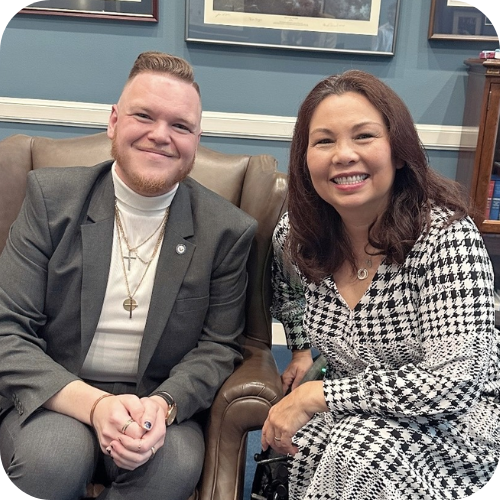
Their dedication helped put my own role in perspective. Advocacy work, whether on or off Capitol Hill, is rarely about immediate victories. More often, it is about sustained effort by people willing to share their stories, insight, and time in order to push institutions toward greater fairness and accountability. Because even incremental progress is progress. The advocates I worked with understood this well, and their voices brought clarity, urgency, and humanity to conversations that might otherwise have remained abstract. Being able to listen to them, learn from them, and work alongside them was one of the most meaningful aspects of the experience, and I regret that I could not do more for them.
While the oversight letters became one of the most memorable moments of my fellowship, they represented only a small part of the work I had the opportunity to engage in. As a policy fellow on Senator Duckworth’s health and disability and Veterans Affairs portfolios, I was exposed to a wide range of legislative and oversight activities. In different ways, I was able to contribute to policy discussions involving inclusive healthcare access, civil rights protections, and mental health initiatives affecting both Veterans and the broader public. Much of this work involved reviewing policy proposals, analyzing potential health implications, incorporating research-informed perspectives into conversations about legislation and oversight, and even drafting original legislation.
These experiences deepened my understanding of how systemic factors like institutional structures, political priorities, and resource allocation shape health outcomes for marginalized communities, including queer and trans populations. They also reinforced how important it is for individuals with backgrounds in health research and clinical practice to participate in policymaking spaces, where decisions affecting millions of people are ultimately made, often by individuals without direct experience in the issues being debated.
As we recognize National LGBTQIA+ Health Awareness Week, I am grateful for the opportunity to reflect on the experiences that shaped my year as a Springfield Congressional Fellow. The fellowship reinforced my strong conviction that improving health outcomes for not only queer and trans folks, but all Americans, requires engagement far beyond clinics and research labs into the institutions where public policy is shaped.
The challenges facing queer and trans communities are complex and deeply tied to the policies that shape access to care, civil rights protections, and social inclusion. Addressing those challenges will require continued collaboration between researchers, clinicians, advocates, and policymakers. This is why programs like the Springfield Fellowship are vitally important. By creating pathways for psychologists with diverse experiences and professional backgrounds to participate in government, the fellowship helps ensure that decisions affecting millions of people are informed by both scientific evidence and human experience.
Remember up top how I politely (and parenthetically) asked you to please hold while psychology works on finding a cure-all strategy for bias? We didn’t find it while you were reading this post that now exceeds APF’s request of me by 1,000 words (you’re welcome), but we are getting closer every day. One of the primary aims of the Franklyn Springfield Awareness Fund is to do exactly this: reduce stigma and build acceptance towards people with LGBTQIA+ identities through cutting-edge research and policy work. Please, if you do not already, consider supporting APF’s work. It is not only life-changing, but life-affirming. Meaningful change is rarely the result of a single moment or policy victory. More often, it emerges from sustained effort, collective action, and the willingness of individuals and communities to keep showing up, speaking out, and working toward a more equitable future. I am so grateful to the American Psychological Foundation for giving me the opportunity to hold the line as I sought to push it forward just a bit. Will you join me?
Your gift to APF helps support the application of psychology in legislative and policymaking spaces. Donate today to directly support initiatives that move psychological science into policy, practice, and real-world impact.
Learn more about APF’s LGBTQIA+ initiatives!
Topics: Child Psychology Children's Mental Health Direct Action Mental Health Where In The World Is APF
Discover More

APF Research Roundup: LGBTQIA+ Physical & Mental Health
At APF, we proudly fund efforts that uplift LGBTQIA+ mental and physical health. Our programs advocate for care, policies, and evidence-based interventions that are accessible, equitable, and affirming.

2026 APF State of the Foundation
Hosted by APF President Dr. Melba Vasquez and APF CEO Dr. Michelle Quist Ryder, this event recapped APF’s impact in 2025 and celebrated the progress made possible by our incredible community. This event featured a first look at the 2025 APF Impact Report, including updates on our Direct Action programs, exciting new partnerships, and the stories and data that defined a truly transformative year for the Foundation (and for the future of psychology)! We also shared a sneak peek of upcoming initiatives that are designed to expand psychology’s reach where it’s needed most.

Partners in Impact with Dr. Diana Slaughter Kotzin | APF Donor Spotlight
Partners in Impact is a space for APF to highlight our donors, whose generosity and partnership enables psychology to tackle some of today’s most important challenges. In our first edition, we’re thrilled to feature Dr. Diana Slaughter Kotzin, who co-founded the Dr. Diana Slaughter Kotzin and Mr. Joseph G. Kotzin Fund Grant.